Quick Answer:
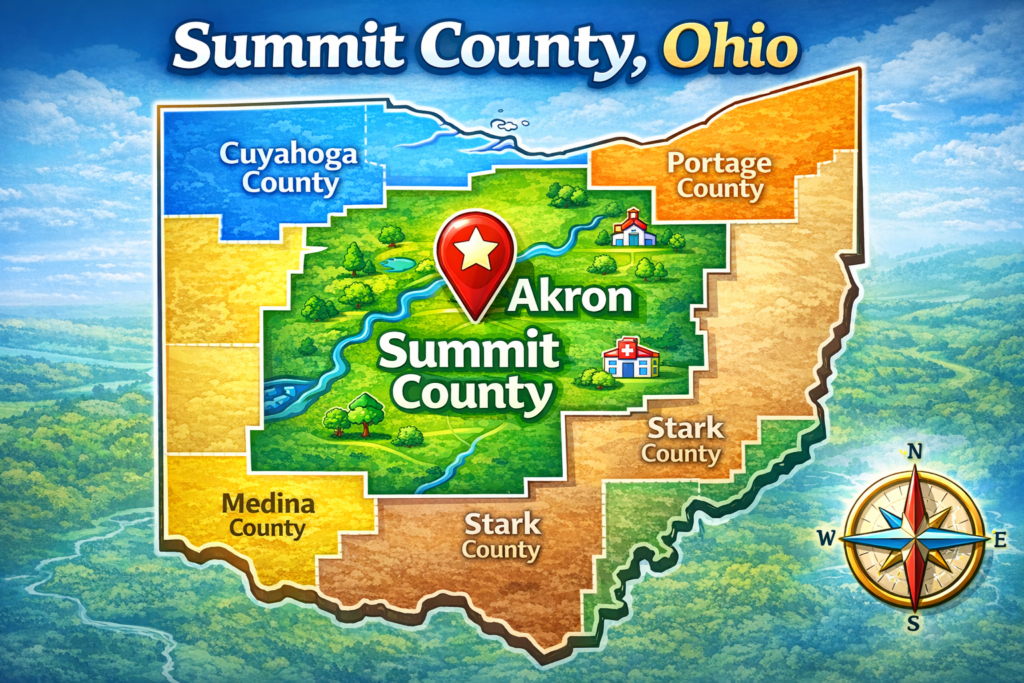
Summit County, Ohio is located in Northeast Ohio and had a population of 541,013 according to the 2020 U.S. Census. The county seat is Akron, which also serves as the largest city. Summit County includes 11 incorporated cities, several villages, multiple townships, and a wide range of ZIP codes that support both urban and suburban communities

About Summit County, Ohio
Summit County, Ohio is a well-established county in Northeast Ohio, known for its strong industrial roots, expanding healthcare sector, and access to higher education. The county was officially founded in 1840 and has since developed into one of the more populous and economically stable counties in the state.
Today, Summit County attracts a wide range of residents, including families, professionals, students, and retirees. Many people choose to live in Summit County due to its mix of affordable housing, employment opportunities, public services, and access to parks and cultural attractions. Whether someone is researching the county for relocation, property ownership, or academic purposes, understanding how Summit County is structured is essential.
This guide provides a clear and factual overview of Summit County’s cities, villages, townships, ZIP codes, demographics, and major institutions, written with homeowners, buyers, and local researchers in mind.
Overview of Summit County
Summit County covers a total area of approximately 419 square miles, the majority of which is land. The county seat, Akron, serves as the administrative and economic hub, housing many of the county’s government offices, courts, and public institutions.
As of the 2020 Census, Summit County had a population of 541,013, placing it among Ohio’s more densely populated counties. While Akron represents the largest urban center, much of the county consists of suburban communities and township-governed areas that provide quieter residential environments.
Tip:
Population figures and boundaries are important when researching property taxes, school districts, and zoning regulations, as these often differ between cities, villages, and townships.
Cities in Summit County, Ohio
Summit County contains 11 incorporated cities, each operating under its own municipal government. Cities are responsible for providing local services such as police and fire protection, road maintenance, zoning enforcement, and public utilities.
Akron is the largest city and functions as the county’s economic and cultural center. Other cities, such as Cuyahoga Falls, Stow, Hudson, and Green, are known for their residential neighborhoods, school systems, and commercial development.
People often search for city-level information when looking into:
- Property ownership and local taxes
- School district boundaries
- City income tax requirements
- Utility and service providers
Because city governments operate independently, services and tax rates can vary significantly even within the same county.
Note:
Some cities, such as Mogadore or Lakemore, may partially extend into neighboring counties, which can affect jurisdiction for certain properties.
Villages in Summit County
Villages in Summit County are smaller incorporated municipalities that maintain their own local government but often rely on surrounding townships or counties for certain services. These communities typically have smaller populations and more limited administrative structures than cities.
Villages like Peninsula and Boston Heights are known for their historic character and proximity to natural areas, including the Cuyahoga Valley National Park. Others, such as Silver Lake, function as residential communities with defined local boundaries.
Important:
Village boundaries may overlap township areas. This means a resident might live in a village but still fall under a township for specific services or tax purposes. Always verify jurisdiction when dealing with property records.
Townships in Summit County, Ohio
Townships govern unincorporated areas of Summit County and play a critical role in local administration. Unlike cities and villages, townships typically focus on zoning, road maintenance, emergency services, and land-use planning rather than full municipal services.
Townships such as Bath, Springfield, and Copley are among the more populous and developed areas, offering suburban living while retaining township governance. These areas are often attractive to homeowners seeking lower population density and different tax structures.
Example:
A homeowner living in a township may pay different property tax rates than someone living in a nearby city, even if the homes are only minutes apart.
ZIP Codes in Summit County, Ohio
Summit County is served by a wide range of ZIP codes, many of which are centered around Akron and its surrounding communities. ZIP codes are used primarily for mail delivery but are frequently referenced in real estate listings, insurance quotes, and demographic research.
Note:
ZIP codes do not always match city or township boundaries. A single ZIP code may serve multiple municipalities, which can sometimes cause confusion when determining school districts or tax jurisdictions.
For accurate property-level information, ZIP codes should always be cross-checked with official county or municipal records.
Demographics of Summit County
Summit County’s population reflects a diverse mix of age groups, educational backgrounds, and household types. The median age of approximately 41.5 years suggests a balanced population that includes working professionals, families, and retirees.
Educational attainment is relatively strong, with a large percentage of residents holding high school diplomas and a growing number earning bachelor’s degrees or higher. These demographics support the county’s workforce and contribute to economic stability.
Economy and Major Industries in Summit County
The economy of Summit County is diverse and resilient, built on both traditional industries and modern service sectors. Manufacturing remains an important part of the county’s identity, particularly in rubber, plastics, and chemical production.
Healthcare and education are among the largest employers, with institutions such as Summa Health, Akron General, and the University of Akron providing thousands of jobs. In recent years, technology and small business development have also contributed to economic growth.
Transportation in Summit County
Summit County benefits from strong regional connectivity. Major highways such as Interstate 76 and Interstate 77 allow residents and businesses to travel easily throughout Northeast Ohio.
Public transportation is provided by the METRO Regional Transit Authority, offering bus services across the county. Air travel is supported by the nearby Akron–Canton Regional Airport, which provides domestic flight options for residents and visitors.
Education in Summit County
Education is a major component of life in Summit County. The county is home to multiple public school districts serving cities, villages, and townships. Higher education opportunities include the University of Akron and regional campuses of Kent State University.
Career and technical education programs are also available, offering workforce training for students and adults seeking specialized skills.
Parks, Recreation, and Culture
Summit County offers extensive recreational and cultural opportunities. Residents have access to Cuyahoga Valley National Park, which provides hiking trails, scenic views, and preserved natural landscapes.
Cultural attractions such as Stan Hywet Hall & Gardens and the Akron Art Museum contribute to the county’s historical and artistic identity. Seasonal events and local festivals further enhance community engagement.
Frequently Asked Questions
What is the population of Summit County, Ohio?
According to the 2020 U.S. Census, Summit County has a population of 541,013 residents.
Is Summit County urban or suburban?
Summit County includes both urban areas, such as Akron, and suburban or semi-rural communities governed by townships.
How do I find property or tax information in Summit County?
Property records, valuations, and tax information are handled by county offices such as the Auditor and Treasurer.